
Robotic PFS Filling And Closing Machine

Robotic PFS Filling And Closing Machine
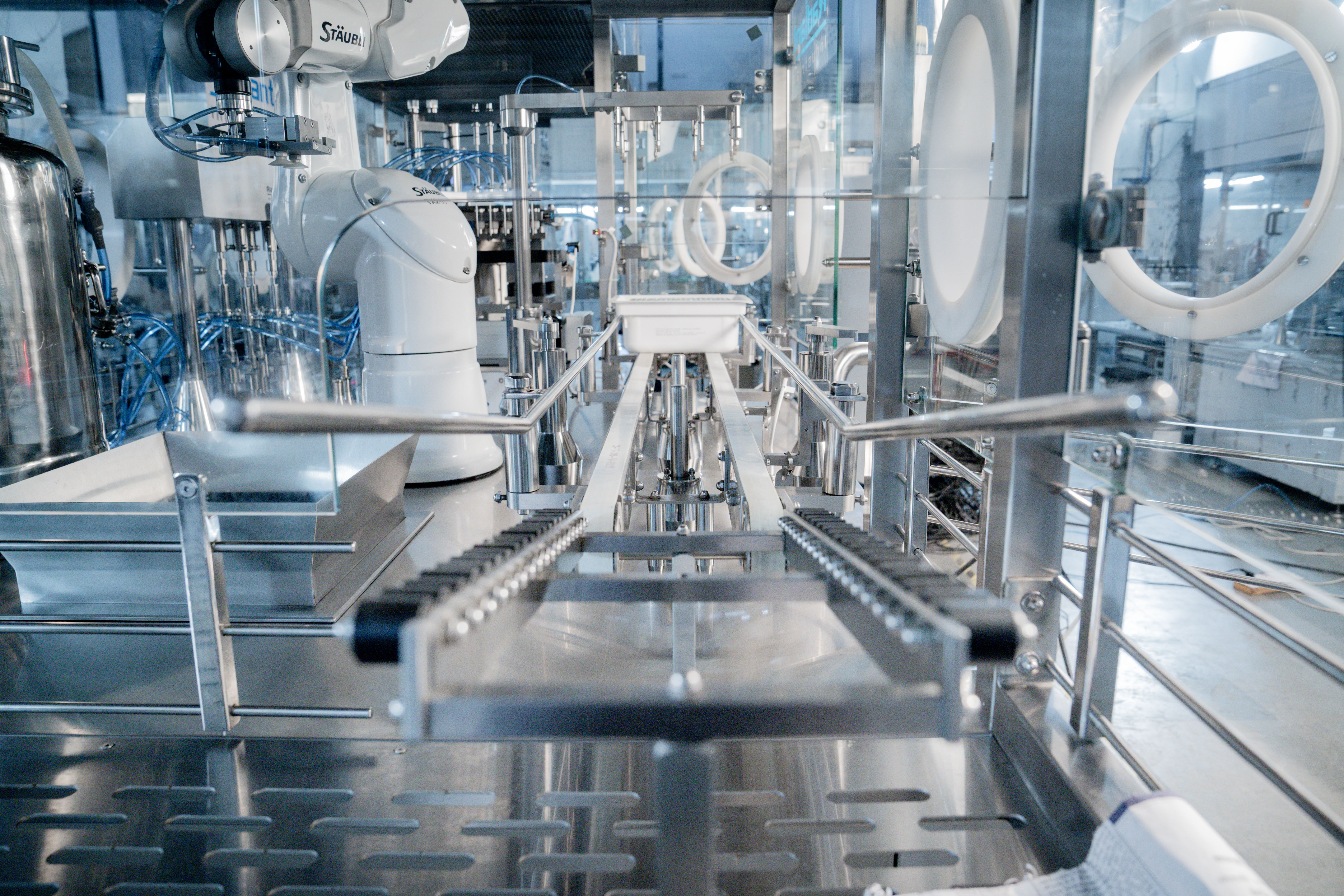
PFS Syringe filling machines – vials and cartridges (RTU)
The machines and lines of the SFM series are designed for processing nested containers such as vials, cartridges and disposable syringes. The dosing station is designed to process liquid products using rotary piston pumps. However, it can also be equipped with alternative dosing technology such as peristaltic pumps or a time-pressure dosing system. Depending on machine type and equipment, nests are supplied manually or fully automatically. Filling and closing are always fully automatic. The machines are also designed for vacuum-assisted dosing and insertion of plunger stoppers. This virtually eliminates entrapped air when filling disposable syringes with pharmaceutical product.
Dosing systems
Rotary piston pumps
The rotary piston pumps comprise only two parts. The dose is defined by the pump stroke setting. They are self-priming and dispense pharmaceutical products very gently and with great precision.
Single-hose peristaltic pumps
Only one product hose is required from the product vessel to the dosing needle. The single-hose peristaltic pumps do not require a Y-manifold, which means that the dosing system itself is very straightforward and easy to use.
Time/pressure dosing system
Product is supplied from a dosing vessel equipped with a precision pressure controller. Only one product hose is required from the pressure controller to the dosing needle. This electronically controlled dosing process allows production data to be acquired and documented.
The rotary piston pumps comprise only two parts. The dose is defined by the pump stroke setting. They are self-priming and dispense pharmaceutical products very gently and with great precision.
Single-hose peristaltic pumps
Only one product hose is required from the product vessel to the dosing needle. The single-hose peristaltic pumps do not require a Y-manifold, which means that the dosing system itself is very straightforward and easy to use.
Time/pressure dosing system
Product is supplied from a dosing vessel equipped with a precision pressure controller. Only one product hose is required from the pressure controller to the dosing needle. This electronically controlled dosing process allows production data to be acquired and documented.
Barrier systems – RABS
Aseptic ambient conditions free of contamination can be created using RABS (Restricted Access Barrier Systems).
- Passive RABS
- Active RABS
- Closed RABS
- Isolator
Taking the building and room situation into account, these systems provide optimum air flow conditions.
Infeed
Outside decontamination, irradiation or aseptic no-touch transfer (NTT)
The transfer of the containers to the aseptic process zone (grade A) is a crucial in the pharma industry. With the new Annex 1 becoming effective, there are new respectively expanded requirements for this process step. It gives a precise description on how to introduce packaging material into the grade A environment, especially focusing on the reduction of the risk of contamination. This is reflected in various points within the Annex 1.
Particularly, in the case of small and medium-sized production quantities, the so-called no-touch transfer (NTT) provides an option for transfer, which is becoming increasingly important alongside decontamination with E-Beam or H2O2.
As the foremost provider, groninger has been at the forefront of pharmaceutical machinery manufacturing. We were among the pioneers in liquid filling machine technology, integrating E-Beam or no-touch transfer technology into our equipment, and obtaining regulatory approval for GMP production.
In the area of non-contact aseptic transfer, it is differentiated between different stages of development:
No-touch transfer (NTT) basic
With the compact NTT basic, the RTU objects are packed in two plastic bags and delivered to the line. The outer bag is manually cut open under a class A laminar air flow and then the tub in the inner bag is pushed over into the class B zone. There the bag is automatically clamped, cut and the tub is transferred semi-automatic to the aseptic filling area (isolator class A/ISO 5).
No-touch transfer (NTT) advanced
The nested objects are also delivered in two bags for the fully automated NTT. The outer bag is clamped manually or automatically, cut open, and the tub in the inner bag is moved over to Class B. This is followed by fully automated bag stretching, followed by fully automated clamping and cutting. The tub is then transported to the aseptic core area (clean room class A/ISO 5).
H2O2
For decontamination with H2O2, a single-packaged bag is manually cut open under laminar class A air floor and transferred to the decontamination chamber. A 6-log outside decontamination of the RTU tub is then carried out using H2O2 and a manual or automatic transition to class A.
E-Beam
For the E-Beam outside decontamination, single bagged RTU containers are unpacked and fed into an e-beam chamber at up to seven units per minute. A 6-log outside decontamination of the RTU tub is carried out with H2O2, followed by an automatic transfer to the aseptic core zone.
Opening
Opening tubs without risk of contamination
Remove Tyvek® film
A robot specifically designed for use in the cleanroom removes the intermediate layer of Tyvek® film.
Benefits:
- Sterile room compatible robot system
- Clear separation of cleanroom areas
- Compact and pharmaceutical grade design
Filling and closing
Whether viscous or fluid: With the correct aseptic filling system, you can accurately fill any type of product – with either rotary piston pumps, peristaltic pumps or a time-pressure filling system. Solutions like single-use or CIP/SIP (cleaning-in-place/sterilization-in-place) for the filling path are available. Upon request, containers can be filled and closed under vacuum.
No matter how you envision your system, together we will develop the optimal solution for you. No matter what you select, the design is compact, easily accessible and easy to operate.
Benefits:
- Filling and closing of nested prefilled syringes, vials and cartridges
- Up to 60,000 pieces per hour
- Filling systems and filling paths to accommodate the product
- Application-friendly systems with integrated in-process control
Technical Specification :
| System | TYVEK REMOVER | Filling Pump/Peristaltic Pump | Closing | Heads | Speed |
|
|---|---|---|---|---|---|---|
| RI/PFS/AUTO/ROB | ROBOTIC | ROBOTIC AUTOMACIT | ROBICIT/Rotary Piston Pump/Peristaltic Pump | Bunging /Vacuum | 10/5/2 | 6500-7200/3500-4500/1200-900 |
| RI/PFS/AUTO/MIC | Mechanical | MECHANICAL AUTOMATIC | Rotary Piston Pump/Peristaltic Pump Rotary Piston | Bunging /Vacuum | 10/5/2 | 5000-6000/2500-3000/1200-900 |
| RI/PFS/AUTO/VAC | Mechanical | MECHANICAL AUTOMATIC | Rotary Piston Pump/Peristaltic Pump | Bunging /Vacuum | 10/5/2 | 5000-6000/ |
Optional Accessories :
- In line Check weighing system
- CIP/SIP System
- Nitrogen Flushing
- IPC With 21 CFR part 11 compliance (scada system)
- Filling is also done by robots
- Monitoring and particle counting
Documentation & Qualification
- In pharmaceutical production, Good Manufacturing Practices (GMP) are essential to guarantee that the manufacturing process is constantly controlled according to quality standards, and the drugs can be used safely.
- Therefore, there must be systems to provide documented proof that correct procedures are consistently followed at each step in the manufacturing process, ensuring clarity and traceability of the product quality data acquisition.
- At RADIANT INDUSTRIES, we defined specific actions to ensure that our document management, which we call GDP (Good Documentation Practices), fulfills this objective.
- Document management starts with the client’s specifications (URS) which help us understand the customer’s needs and define the machine’s configuration accordingly. The required machines’ functionality will be tested later during the qualification tests.
- The whole process is described in the picture below, showing the comprehensive Qualification Project Plan (QPP) that covers from mechanical assembly to software and control configuration:
COMPLETE SOLUTIONS FOR PRE-FILLED SYRINGE
PRODUCTION LINE BY RADIANT
INDUSTRIES


