

BCT Cap & Rubber Assembly Machine
Operational Process
-
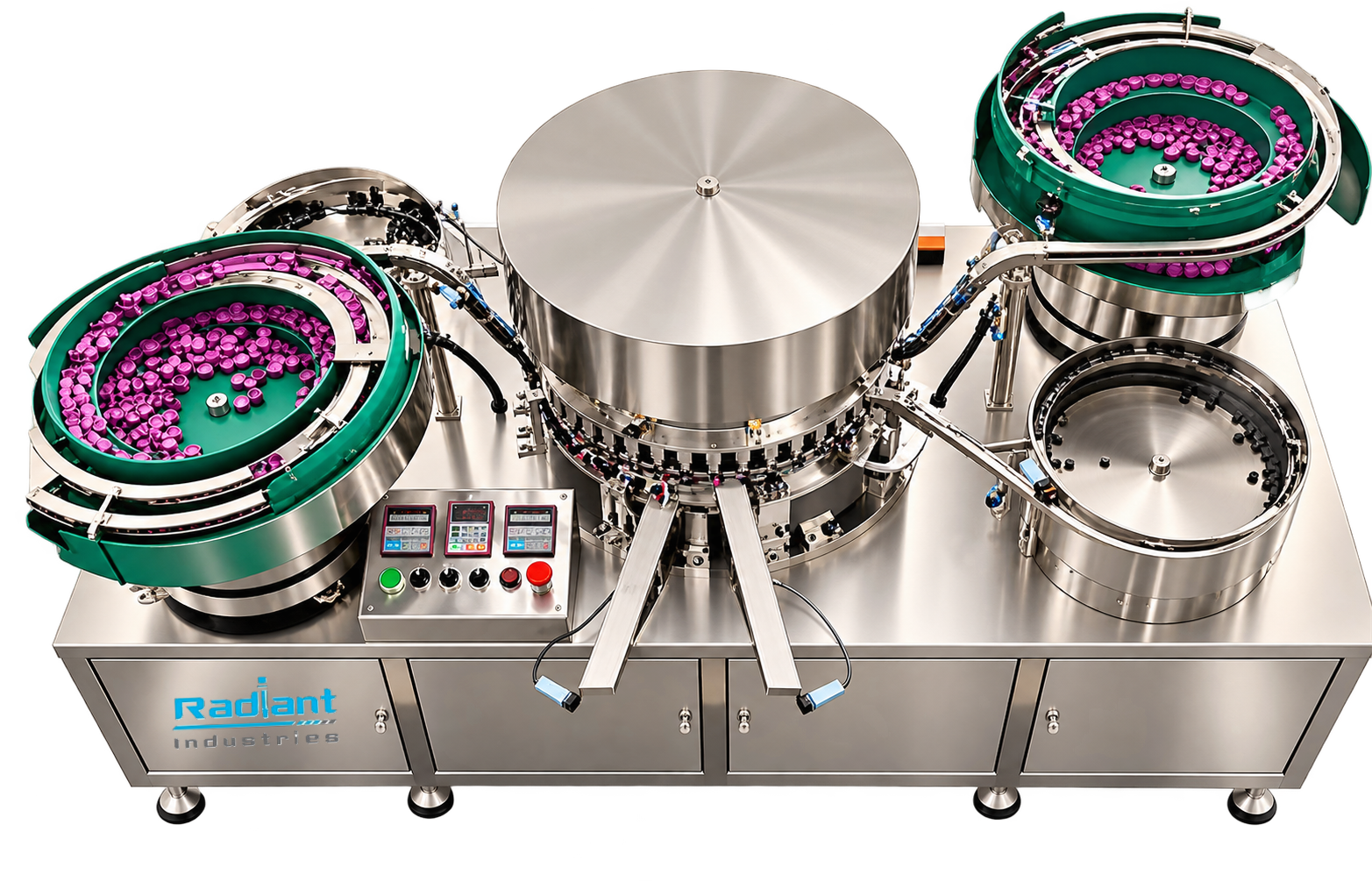
The BCT Cap Rubber Assembly Machine is a fully automatic machine designed to assemble rubber stoppers (elastomer closures) into plastic caps used for Blood Collection Tubes (BCT). The machine ensures accurate orientation, insertion, and secure assembly of the rubber stopper inside the cap before the assembled caps are transferred to the tube capping machine. The system provides high-speed, reliable, and contamination-free assembly suitable for GMP-compliant manufacturing.
Plastic Cap Feeding: –
The plastic cap feeding process supplies plastic caps to the assembly machine through a hopper or vibratory bowl feeder. The caps are loaded into the feeding system, which organizes them and prepares them for automatic transfer to the assembly station.
The vibratory bowl feeder separates and orients the caps in the required direction. Properly oriented caps are transferred through a linear feeding track, ensuring a continuous supply to the assembly mechanism and maintaining a smooth production flow.
Sensors monitor cap availability and can detect feeding interruptions, jams, or incorrect cap orientation. When an abnormal condition is detected, the system can trigger an alarm or pause the feeding operation, helping reduce component handling errors and maintain consistent machine performance.
Rubber Stopper Feeding : –
The rubber stopper feeding process supplies rubber stoppers to the machine using a dedicated hopper and vibratory bowl feeder. The system organizes the stoppers and prepares them for accurate insertion into the plastic caps.
The vibratory feeder separates individual stoppers and aligns them in the correct orientation. Overlapping, incorrectly positioned, or improperly oriented stoppers can be rejected or recirculated, depending on the machine configuration, to maintain a consistent supply of suitable components.
Once correctly oriented, the rubber stoppers move along a linear track toward the insertion station. This automated feeding arrangement helps minimize manual intervention, maintain a continuous assembly cycle, and improve production efficiency.
Cap and Rubber Presence Detection: –
The cap and rubber presence detection process verifies the availability and positioning of both components before assembly begins. Photoelectric sensors, proximity sensors, or other suitable detection devices can be used to check whether a plastic cap and a rubber stopper are present at their designated positions.
The detection system checks the component supply and, where supported by the sensor arrangement, verifies the correct orientation of the cap and stopper. These checks help ensure that the assembly mechanism operates only when the required components are available and suitably positioned.
If either component is missing or incorrectly aligned, the machine can skip the assembly cycle and generate an alarm. This function helps prevent incomplete assemblies, reduce component wastage, and support reliable operation of the automatic assembly process.
Automatic Rubber Insertion: –
The automatic rubber insertion process places the rubber stopper into the corresponding plastic cap. A servo-controlled or pneumatic pick-and-place mechanism transfers the stopper from the feeding track and positions it accurately above the cap.
The insertion mechanism applies a controlled force to press the rubber stopper into the plastic cap. The insertion movement is designed to achieve the required seating position while minimizing the risk of damaging, deforming, or incorrectly fitting either component.
Insertion parameters, such as movement position, force, or stroke, can be configured according to the machine design and component specifications. Controlled insertion helps achieve a secure fit and consistent assembly quality across production cycles.
Assembly Verification: –
The assembly verification process checks the quality and completeness of the assembled cap and rubber stopper. Integrated sensors or an optional vision inspection system can verify the presence of the rubber stopper inside the plastic cap and assess whether the components have been assembled correctly.
Depending on the inspection system, verification may include checking the stopper’s seating depth, component alignment, and overall assembly condition. These checks help identify missing stoppers, improper insertion, or other visible assembly defects before the components are transferred to the next stage.
If a defective assembly is detected, the machine can trigger an alarm or automatically reject the affected component when a rejection mechanism is available. This process supports consistent assembly quality and reduces the likelihood of defective cap-and-stopper combinations reaching the tube capping operation.
Finished Product Collection: –
The finished cap discharge process transfers successfully assembled plastic caps and rubber stoppers from the assembly station to the designated outlet conveyor or collection hopper. The discharge mechanism handles the assembled components in a controlled sequence to maintain a continuous production flow.
The assembled components are collected and organized for transfer to the next manufacturing stage. Depending on the machine configuration, an automatic conveying system can supply the components directly to a compatible Blood Collection Tube Capping Machine.
Automatic discharge reduces manual handling and helps coordinate the cap assembly process with downstream tube sealing operations. Consistent component transfer supports production efficiency and helps ensure that assembled caps are available when required by the capping machine.
Always Ready to Serve!
Radiant Industries is committed to delivering quality, innovation, and reliability across every project we undertake.