

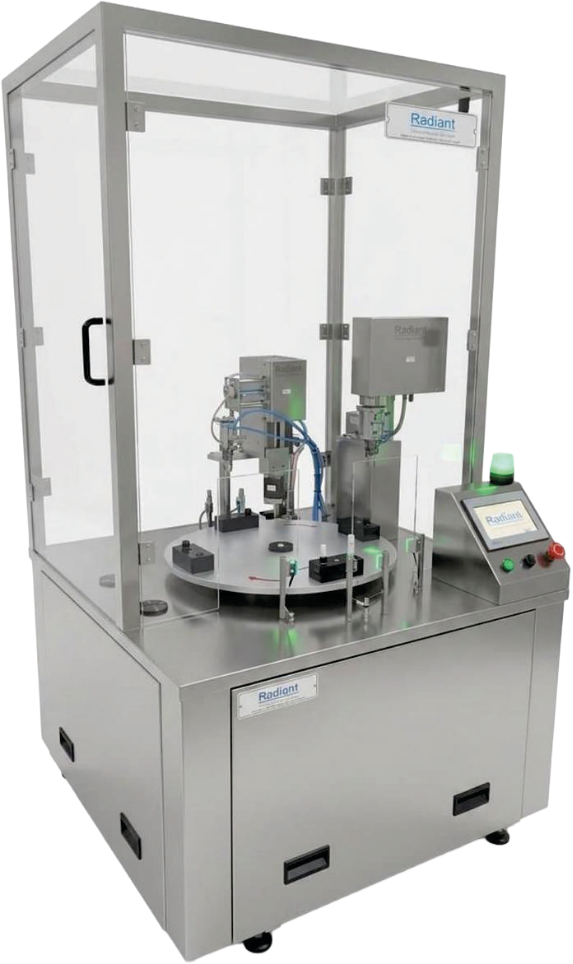
Automatic pen device assembly machine
Operational Process
-
The Automatic Pen Device Assembly Machine is designed for the efficient and precise assembly of pen-type medical devices, including injection pen components. The machine automates multiple assembly operations such as component feeding, positioning, insertion, fitting, and controlled assembly, ensuring smooth and consistent production with minimal manual intervention.
- Designed for high-precision and reliable manufacturing, the machine provides accurate component handling, repeatable assembly, and optimized production flow. Its automated operation helps improve productivity, reduce assembly errors, and maintain consistent product quality, making it suitable for pharmaceutical, medical device, and healthcare manufacturing applications.
Pen components are automatically fed through bowl feeders, magazines, or robotic handling systems : –
The assembly process begins with the automatic feeding of individual pen components into the machine. Components such as pen bodies, cartridges, springs, plungers, buttons, clips, and other parts are supplied through vibratory bowl feeders, linear feeders, magazines, or robotic handling systems.
The feeding system is designed to orient each component correctly before it reaches the assembly station. This ensures that every component is presented in the required position and direction, reducing manual intervention and improving overall assembly consistency.
Once oriented, the components are transferred through precision conveyors or transfer mechanisms to the designated assembly stations. Sensors continuously monitor component movement and confirm that the required parts are available before the next operation begins.
The automatic feeding system helps maintain a continuous supply of components to the machine. This reduces loading errors, minimizes operator dependency, and supports stable production during long-duration machine operation.
Different component feeding systems can be configured according to the shape, size, material, and production requirements of the pen device. This provides flexibility for handling multiple components within a single automated assembly line.
Overall, the automatic feeding section ensures smooth, controlled, and synchronized component supply, creating a reliable starting point for the complete pen assembly process.
Automated stations perform component insertion, locking, pressing, screwing, and functional assembly : –
After feeding, the components are transferred to automated assembly stations where individual parts are accurately assembled into the pen device. Depending on the design, the machine can perform operations such as component insertion, locking, pressing, screwing, fitting, and functional assembly.
Precision mechanical mechanisms are used to position each component correctly before the assembly operation takes place. This ensures that parts are assembled according to the specified dimensions and sequence.
The machine can automatically insert internal components, position springs or plungers, fit cartridges, and assemble external pen components. Each operation is synchronized with the machine cycle to maintain consistent production.
Pressing and locking operations are performed using controlled pneumatic, servo, or electric mechanisms, depending on the machine configuration. These systems provide controlled force and movement to help prevent component damage during assembly.
For screw-type components, automatic screw-feeding and tightening systems can be integrated into the machine. The tightening process can be controlled to achieve consistent assembly and reduce variation between individual devices.
By combining multiple assembly operations into an automated sequence, the machine provides high repeatability, reduced manual handling, and consistent assembly quality throughout the production process.
Sensors and vision systems verify component presence and assembly accuracy : –
During the assembly process, sensors and inspection systems continuously monitor the presence and position of components. Sensors verify whether the required component has been correctly loaded before the machine proceeds to the next operation.
The machine can use photoelectric sensors, proximity sensors, position sensors, and other detection systems to monitor different stages of the assembly process. These sensors help identify missing, incorrectly positioned, or improperly transferred components.
Vision inspection systems can also be integrated for more detailed quality verification. Cameras can inspect component orientation, presence, positioning, alignment, and other visible assembly characteristics.
If an incorrect or incomplete assembly is detected, the machine can automatically stop the relevant operation or identify the product as a rejected unit. This helps prevent defective products from continuing through the production line.
Inspection data can be monitored through the machine’s HMI or control system, allowing operators to view machine status, alarms, inspection results, and production information.
This combination of automatic sensing and vision inspection helps maintain consistent assembly quality and provides better control over the complete manufacturing process.
Rejected components are separated automatically, while accepted devices move to the next stage : –
After assembly and inspection, each completed pen device is evaluated according to the predefined quality parameters. Products that successfully pass the inspection process are classified as accepted units.
If a component is missing, incorrectly assembled, improperly positioned, or fails the specified inspection criteria, the machine automatically identifies the unit as a rejected product. This reduces the need for manual inspection and handling.
Rejected units are automatically separated from the main production flow using pneumatic ejectors, mechanical mechanisms, robotic pick-and-place systems, or dedicated rejection conveyors, depending on the machine configuration.
Accepted pen devices continue automatically to the next production stage through conveyors or synchronized transfer mechanisms. The transfer system maintains the correct orientation and spacing of products for downstream operations.
The automatic separation of accepted and rejected products helps prevent defective units from moving forward in the manufacturing process. It also improves production traceability and supports consistent quality control.
The complete process—from automatic feeding and assembly to inspection, rejection, and product transfer—works as a synchronized automated sequence, providing efficient and reliable pen device production with reduced manual intervention.